SOUTHEAST ASIAN YOUTH AND SUSTAINABLE CONSUMPTION TRENDS IN THE DIGITAL ERA
- Introduction
Born and raised in the era of data, young people across Southeast Asia are not merely passive recipients of global trends; they are actively redefining what sustainable consumption means. Yet the intersection of a rapidly expanding digital economy, proliferating e-commerce platforms, and intensifying climate pressures does not follow a simple upward trajectory. This complex landscape compels us to move beyond asking whether younger generations care about sustainable consumption and to confront a more fundamental question: does environmental awareness actually translate into behavioral change? The future of sustainable consumption in the region hinges largely on whether digital technologies are purposefully directed toward ecological value creation or whether they continue to entrench short-term consumerism.
2. 2. Sustainable Consumption Trends Among Southeast Asian Youth
Among young demographics, sustainability has emerged as a primary determinant in purchasing behavior, driven by the consensus that climate change poses the most profound global threat to their future superseding concerns over inflation or financial volatility.[1] In Vietnam, 73% of consumers, particularly Generation Z and Millennials, exhibit deep concern for environmental integrity, increasingly emphasizing personal accountability in ecological preservation.[2] At the same time, Gen Z also represents a consumer generation that spends more while being more selective, prioritizing meaningful experiences and transparency regarding product origins.[3]
2.1 Innovative Digital Consumption Models
The digital era has not only transformed how young people conceptualize products but has also equipped them with effective tools to adopt sustainable behaviours with unprecedented ease. Technology is progressively dismantling the barriers of inconvenience and cost that once impeded more responsible consumption. In Thailand, Singapore, and Hong Kong, the Yindii application is at the forefront of the fight against food waste. Rather than allowing surplus meals from restaurants and bakeries to be discarded at the end of each day, Yindii directly connects these offerings to young consumers via a digital platform at significantly reduced prices.[4] Alongside such initiatives, the platform Carousell has substantially simplified the second-hand marketplace experience. Through a few taps, users can extend the lifespan of millions of items from clothing to electronics, actively reshaping the cultural perception of pre-owned goods.[5]

Source: https://vietnamnews.vn/media-outreach/1732503/yindii-turns-food-waste-into-value-saving-500-000-meals-in-2025.html
2.2 Youth-Led Action and Green Entrepreneurship
What distinguishes Southeast Asian youth is not merely their capacity to leverage existing platforms for smarter purchasing decisions, but their refusal to wait for solutions from governments or large corporations. Increasingly, young people are positioning themselves as architects of change. Youth-led startups are reshaping industries from fashion to agriculture through innovative and impact-driven business models, marking a decisive shift from passive consumption to active co-creation. Notable among these are the youth-led initiatives within the Global Shapers Community, which focus on enhancing technological capacity and digital literacy, with a priority on implementing practical solutions for renewable energy and sustainable development. The core philosophy of this network is rooted in the belief that substantive change cannot occur solely top-down; it must be catalysed through bottom-up action at the city level, with young people as empowered agents. Between 2024 and 2025, the network implemented more than 800 projects, directly supported 134,000 individuals, and reached over 2.2 million people through digital platforms and community campaigns.[6]

Source: https://www.globalshapersbangkok.org/projects/plant-planet
In Vietnam, a flourishing wave of social impact startups is being nurtured by international support networks, most notably the Youth Co:Lab incubation program, co-founded by UNDP and the Citi Foundation. Among the emerging models, HUBTECH ASIA offers a comprehensive agricultural management and connectivity platform; REshare facilitates the collection and processing of used clothing to extend product lifecycles and reduce fashion waste;[7]and WINDOU connects users with recycling points while employing AI to calculate the carbon reductions achievable through specific individual actions.[8]
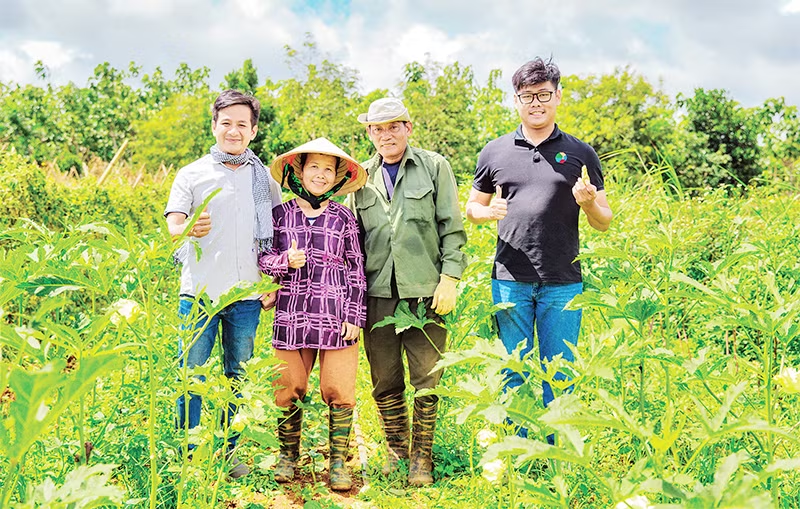
Srouce: https://nhandan.vn/nuoi-hoai-bao-de-duoc-la-chinh-minh-post793188.htm
The textile and garment sector among the most polluting industries globally offers particularly instructive examples of this innovation dynamic. Major international fashion brands such as Ralph Lauren and Cotopaxi are deploying blockchain and AI-powered tools (including software such as Materia MX) to restructure product lifecycles.[9] Inspired by these concepts, Vietnamese startups are also applying artificial intelligence to optimise cutting processes and minimise fabric waste.[10] Nhìn sang Philippines, Panublix nổi lên với ý tưởng kết nối tính bền vững của sinh thái với sự công bằng kinh tế xã hội. Panublix là một startup sử dụng các loại sợi tự nhiên từ dứa và chuối để tạo ra các loại vải bền vững, đồng thời xây dựng một nền tảng kỹ thuật số để kết nối các nghệ nhân dệt may vùng nông thôn với thị trường thời trang toàn cầu.[11] Examples include DELIGENT, which uses AI to streamline T-shirt design and production workflows, and SENONIKA, which employs AI-driven design and 3D printing using recycled waste materials.
3. 3. Macro-policy and Capacity-Building Education
While the behavioral shift among the youth is a positive indicator, transforming this trend into a sustainable eco-social transition for society as a whole requires a supportive ecosystem spanning policy, education, and technical infrastructure. Recognising the central role of young people, the ASEAN Work Plan on Youth 2021–2025 places strategic emphasis on developing innovation-friendly education systems and enabling youth to participate directly in high-level policy decision-making processes. In alignment with SDG 12 of the United Nations 2030 Agenda for Sustainable Development, young people are positioned not merely as subjects of policy, but as the principal agents of transition.[12] In practice, the ASEAN Higher Education Space is advancing the digital transformation of education, facilitating student mobility across the region, and equipping graduates with the green transition competencies required to navigate climate change.[13] In parallel, the EcoRise platform in Southeast Asia is integrating climate education into secondary and tertiary curricula, establishing an academic foundation from which future generations of sustainability-oriented actors can emerge.[14] Contributing to this momentum, the SETY Camp project organised by the Institute of Policy Innovation and Interdisciplinary Sciences (IPIIS) and supported by the Rosa Luxemburg Stiftung Southeast Asia (RLS SEA) plays a concrete role in strengthening young people's research capacity in eco-social transition, community development, and systems-oriented sustainability thinking.
4. Conclusion
Southeast Asian youth demonstrate a distinctive combination of technological fluency, data literacy, and awareness of resource scarcity and climate change; this generation is continuously expanding the boundaries of the consumer economy toward greater responsibility. Yet this potential can only be fully realised through the simultaneous fulfilment of three enabling conditions: policy frameworks that establish conducive institutional environments; education systems that cultivate systems thinking and green competencies; and, most critically, digital platforms that are deliberately oriented toward ecological value creation rather than the amplification of short-term consumerism. ASEAN's digital economy can only achieve genuine and lasting prosperity when the convenience offered by technology is aligned with the preservation of the planet's natural rhythms.
[1] NielsenIQ. (2025, November 4). Southeast Asia’s consumers are redefining value amidst headwinds, powering a $5 trillion consumption future by 2035. NIQ.
[2] Tran, M. (2024). To target younger consumers, brands need to do more for the environment. Vietcetera.
[3] NielsenIQ. (2025, November 4). Southeast Asia’s consumers are redefining value amidst headwinds, powering a $5 trillion consumption future by 2035. NIQ.
[4] Vietnam News. (2025). Yindii turns food waste into value, saving 500,000+ meals in 2025. Truy cập từ https://vietnamnews.vn/media-outreach/1732503/yindii-turns-food-waste-into-value-saving-500-000-meals-in-2025.html (ngày truy cập 18/04/2026)
[5] Affifa. (2024). E-commerce Odyssey in Southeast Asia: Exploring Trends and Triumphs. Cube Asia.
[6] World Economic Forum. (2025). Global Shapers Community Annual Report 2024-2025.
[7] Nguyễn Hà (2024). Nuôi hoài bão để được là chính mình. Báo Nhân Dân Điện Tử.
[8] Khánh Linh (2024). 10 student startups at Startup Wheel 2024. Startup Wheel.
[9] Gazzola, P., Pavione, E., Hillebrand, R., Vota, V., & Rosa, R. (2025). The circular economy and the role of technology in the fashion industry: A comparison of empirical evidence. Sustainability, 17(7), 3104. https://doi.org/10.3390/su17073104
[10] Khánh Linh (2024). 10 student startups at Startup Wheel 2024. Startup Wheel.
[11] World Intellectual Property Organization. (2022). Well-knit: building a stable platform for sustainable fashion in Southeast Asia. WIPO.
[12] The ASEAN Secretariat. (2022). ASEAN work plan on youth 2021-2025. The ASEAN Secretariat, Jakarta.
[13] ASEAN. (2022). Roadmap on the ASEAN higher education space 2025.
[14] INTI International University. (n.d.). EcoRise Southeast Asia 2025. https://newinti.edu.my/esg/index.php/home-ecorise-copy/
Leave A Comment