
REGULATORY SANDBOX: FOSTERING FINANCIAL TECHNOLOGY INNOVATION IN ASEAN
Introduction
In the era of digital transformation, the rapid advancement of Financial Technology (FinTech) has fundamentally reshaped the global financial services landscape. From mobile banking applications to digital payment platforms, FinTech integrates technological innovation with financial services to deliver transactions that are faster, more secure, and more convenient [1] . FinTech has become not only an enabling force but also a key driver that strengthens the global competitiveness of financial centers. ASEAN has emerged as one of the world's most dynamic FinTech markets, with its population projected to reach approximately 700 million by 2026 (Statista, 2026). Despite this growth potential, the region continues to face significant financial inclusion challenges. Approximately 438 million people, accounting for nearly 73% of the population, remain unbanked, particularly in lower-income countries such as Cambodia, where only around 5% of the population has access to formal banking services. In contrast, mobile phone penetration across ASEAN exceeds the global average, with particularly rapid growth observed in Myanmar, Cambodia, Vietnam, and Thailand. This disparity presents substantial opportunities for FinTech startups to expand financial access and develop innovative digital financial solutions. [2]
Nevertheless, the fragmented and complex regulatory frameworks across different jurisdictions impose significant compliance burdens on FinTech startups. Companies are required to strike a balance between maintaining low-cost business models and meeting increasingly stringent regulatory requirements (Treleaven, 2015). While rigorous regulations are essential for safeguarding financial system stability, they may unintentionally impede innovation by prolonging licensing procedures and exposing firms to substantial legal risks when regulatory obligations remain ambiguous (Treleaven, 2015; Rampton, 2017). Consequently, these regulatory barriers may discourage the development of innovative FinTech products and services, highlighting the need for more adaptive regulatory approaches that can facilitate innovation while maintaining market integrity. Against this backdrop, the Regulatory Sandbox has emerged as an innovative regulatory instrument that enables FinTech firms to test new products, business models, and financial services within a controlled regulatory environment. By allowing experimentation under the supervision of regulatory authorities while limiting potential legal and systemic risks, regulatory sandboxes provide an effective mechanism for promoting responsible financial innovation throughout the ASEAN region.
- Introduction to Financial Technology (FinTech)
Financial Technology (FinTech) refers to the application of innovative technologies to financial services in order to develop more efficient, accessible, and customer-oriented financial products and solutions. According to the Financial Stability Board (FSB, 2019), FinTech is defined as: "Technology-enabled innovation in financial services that could result in new business models, applications, processes, or products with a material effect on financial markets and institutions." FinTech encompasses a broad spectrum of financial innovations, including electronic payments, digital asset management, peer-to-peer (P2P) lending, blockchain technology, and cryptocurrencies. Importantly, FinTech extends beyond start-up enterprises to include traditional financial institutions, such as banks, that leverage emerging technologies to optimize operational efficiency and enhance service delivery. [3]
The 2008 Global Financial Crisis significantly eroded public trust in conventional banking systems while simultaneously creating opportunities for technology-driven startups. Characterized by their agility and capacity for innovation, these companies introduced customer-centric financial services that transformed the financial industry through mobile payment platforms, peer-to-peer lending services, and numerous other digital financial solutions..
Since its emergence, FinTech has pursued several fundamental objectives: (1) Enhancing financial accessibility. FinTech enables individuals living in remote areas, as well as those who are unbanked or underbanked, to access essential financial services through mobile devices and digital platforms; (2) Improving operational efficiency. By automating traditionally manual processes, FinTech reduces operational costs and significantly accelerates transaction processing. For example, artificial intelligence (AI)-driven credit assessment systems can reduce loan approval times from several weeks to only a few minutes; (3) Enhancing customer experience. FinTech provides personalized financial services through user-friendly interfaces and seamless digital processes, placing customers at the center of financial service design rather than focusing solely on financial products; (4) Promoting competition and innovation. The emergence of FinTech companies has encouraged traditional financial institutions to modernize their business models, thereby fostering a more competitive financial ecosystem that ultimately benefits consumers through improved service quality, greater efficiency, and increased innovation.[4]
2. Definition, Roles, and Operational Process of the Regulatory Sandbox
Định nghĩa A Regulatory Sandbox (RS) is a key instrument of Regulatory Experimentation (RE). It refers to a controlled regulatory environment in which regulatory authorities temporarily relax or adapt certain regulatory requirements to enable the testing of innovative products, services, or business models with reduced legal constraints. The primary objective of a regulatory sandbox is to better understand both the opportunities and the risks associated with emerging innovations, thereby enabling policymakers to develop regulatory frameworks that effectively accommodate technological advancements (OECD, 2024; Federal Ministry for Economic Affairs and Climate Action of Germany, 2023).
First, it can be understood that A Regulatory Sandbox can be understood as a controlled testing environment designed for innovative financial technology (FinTech) products and services. Within this environment, firms are permitted to develop and test innovative solutions under predefined regulatory boundaries. Much like building a sandcastle within a sandbox, any failure remains confined to a safe and controlled space, preventing adverse consequences from extending beyond the testing environment. Unlike products deployed directly into the market, FinTech solutions participating in a regulatory sandbox operate under the close supervision of regulatory authorities and must comply with clearly specified limitations regarding the testing period, the number of participating customers, transaction volumes, and the scope of services provided. These safeguards ensure that any risks, operational errors, or unforeseen incidents arising during the testing process remain contained within the sandbox, thereby preventing their escalation into systemic risks that could threaten the stability of the broader financial system.
Through this controlled experimentation process, regulatory authorities are able to assess the feasibility of innovative products, identify and mitigate potential risks, and collect empirical evidence to inform the refinement of regulatory frameworks before authorizing full-scale market deployment. For participating firms, the sandbox provides an opportunity to validate business models and technological solutions under real-world conditions while reducing compliance costs and regulatory uncertainty. For governments and consumers, the mechanism helps minimize the potential adverse impacts of technological innovation, safeguard the stability and integrity of the financial system, and enhance regulatory effectiveness. Consequently, the Regulatory Sandbox is widely recognized as an important policy instrument for striking an appropriate balance between fostering innovation and ensuring the stability, transparency, and sound governance of financial markets.
Process:

Caption (from left to right): FinTech Innovators: FinTech enterprises/innovators; Disruptive FinTech Technology: Disruptive FinTech technologies; FinTech Technology Licensing and Implementation: FinTech technology licensing and implementation; Regulatory Sandbox: Regulatory Sandbox mechanism; Regulators and Supervisory Institutions: Regulatory and supervisory authorities; Research Centers: Research centers.
(Source: https://www.civilsdaily.com/news/on-the-importance-of-regulatory-sandboxes-in-artificial-intelligence/)
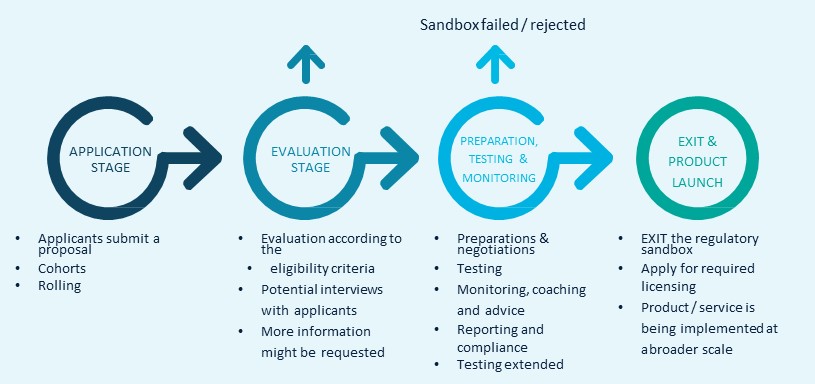
Caption from left to right: Phase 1 – Application Submission PhaseBusinesses submit applications to participate in the Sandbox; applications are accepted in batches; applications are accepted on a rolling basis. Phase 2 – Assessment Phase: Assessment based on eligibility criteria; interviews with businesses (if necessary); requests for additional information (if necessary). Phase 3 – Preparation, Testing, and Supervision Phase: Preparation and agreement on the testing conditions; implementation of the test; monitoring, guidance, and consultation; reporting and regulatory compliance; extension of the testing period (if necessary); failure to meet requirements or rejection. Phase 4 – Testing Completion and Product Deployment Phase: Completion of the Sandbox program; completion of formal licensing procedures; deployment of the product or service in the market on a larger scale.
(Source: https://digitalregulation.org/a-case-for-ict-regulatory-sandbox/)
The implementation of a Regulatory Sandbox typically consists of five sequential phases: design, initiation, operation, testing completion, and programme closure. The process begins with regulatory authorities establishing the regulatory framework, eligibility criteria, and scope of the sandbox. FinTech firms then submit applications to participate in the programme. Following the application and selection process, participating firms are permitted to test their innovative products within a controlled environment under the close supervision of regulatory authorities. Upon completion of the testing phase, regulators evaluate the outcomes to determine whether the innovation should be granted regulatory approval, require further modifications, or have its participation in the sandbox terminated. Finally, the insights and lessons gained from the experimentation process are used to refine the regulatory framework and strengthen policies governing the FinTech sector.
3. The Implementation of Regulatory Sandboxes for FinTech Innovation in ASEAN
The Regulatory Sandbox was first introduced in the United Kingdom in 2016 and subsequently adopted by many other countries, including those in Southeast Asia. By 2020, according to the World Bank, 57 countries had implemented regulatory sandbox frameworks, with 73 sandbox programmes specifically established to support FinTech companies. [5]
According to the World Bank (2020), regulatory sandboxes can be broadly classified into four categories: (i) policy-focused sandboxes, (ii) product- or innovation-focused sandboxes, (iii) thematic sandboxes, and (iv) cross-border sandboxes. These categories, however, are not mutually exclusive, and a single sandbox programme may encompass multiple characteristics. [6]
Since 2016, the adoption of regulatory sandbox initiatives has accelerated considerably across Southeast Asia. By 2023, the region had established 39 regulatory sandboxes spanning a wide range of sectors, including financial technology (FinTech), healthcare, transportation, unmanned aerial vehicles (drones), agriculture, energy, environmental protection, the built environment, and education. More than half of these 39 sandbox programmes were launched within the preceding three years, reflecting the rapid expansion of regulatory experimentation in the region. Most sandbox initiatives were introduced in 2020, and this growth momentum continued throughout 2021 and 2022, with six new sandbox programmes being established each year.[7
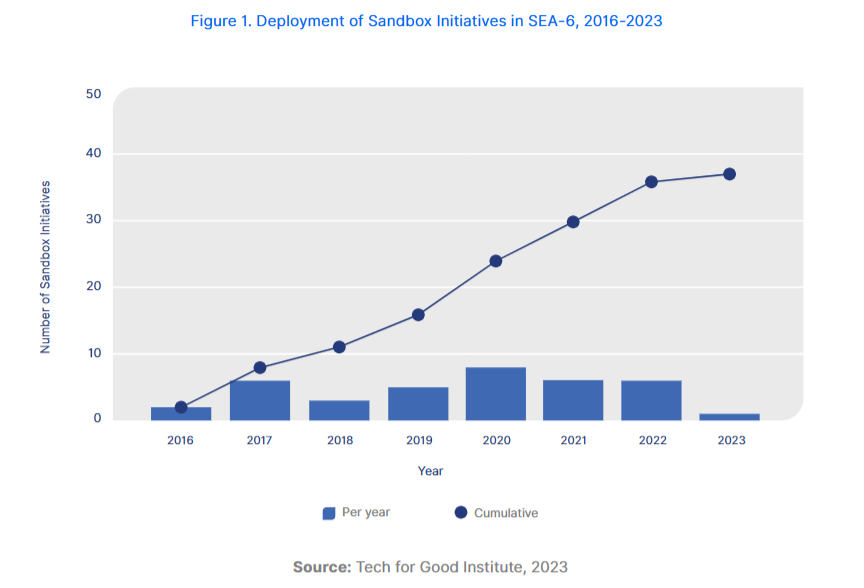
(Source: Detros, K., & Lim, S. (2024). Sandbox to society: Fostering innovation in Southeast Asia. Tech for Good Institute.)
As of the 2025–2026 period, Regulatory Sandboxes had been implemented in at least eight of the ten ASEAN Member States, with the majority of initiatives focusing on the FinTech sector. Beyond conventional FinTech regulatory sandboxes, several countries, notably Singapore and Malaysia, have expanded their sandbox frameworks to encompass emerging areas such as artificial intelligence (AI), data protection, and digital assets. This development reflects a broader trend toward the diversification of regulatory sandbox models as a means of fostering innovation and supporting the growth of the digital economy. [8]
Singapore: The MAS Regulatory Sandbox – Driving Innovation in Digital Capital Markets
Singapore was the first ASEAN Member State to introduce a Regulatory Sandbox in 2016, under the supervision of the Monetary Authority of Singapore (MAS). During the testing period, MAS may grant temporary regulatory relaxations for participating firms while maintaining compliance with core regulatory requirements, particularly those relating to anti-money laundering (AML), customer protection, and risk management. These safeguards ensure that financial innovation can be tested in a controlled environment without compromising the integrity, stability, or security of the financial system.[9].

A notable example is ADDX (formerly iSTOX). The company participated in the MAS Regulatory Sandbox to test a blockchain-based platform for the issuance and trading of digital securities. Upon successfully completing the sandbox programme, ADDX was granted a full licence by the Monetary Authority of Singapore (MAS) and became one of the first digital securities platforms in Asia. The platform has played a significant role in the digitalization of financial assets while expanding investors access to capital markets through the tokenization and trading of digital securities. [10]

Malaysia: The MoneyMatch Case - Innovating Cross-Border Remittance Services
Malaysia introduced its Regulatory Sandbox in 2016 under the supervision of Bank Negara Malaysia (BNM) to support FinTech firms in developing innovative financial solutions while maintaining the safety and stability of the financial system. A notable success story is MoneyMatch, a FinTech company specializing in international remittance services. During its participation in the Regulatory Sandbox, MoneyMatch was permitted to test its remittance services under predefined limitations on the number of participating customers and transaction values. At the same time, the company was required to comply with key regulatory requirements, including Know Your Customer (KYC) procedures, Anti-Money Laundering (AML) regulations, and periodic reporting obligations to the regulatory authority. After demonstrating the safety, reliability, and commercial viability of its business model, MoneyMatch was granted a full operating licence by Bank Negara Malaysia. The successful implementation of this regulatory sandbox enabled MoneyMatch to reduce remittance costs, shorten transaction processing times, and enhance the competitiveness of Malaysia's international payment services market. Furthermore, the case illustrates how regulatory sandboxes can facilitate responsible financial innovation while ensuring regulatory compliance and maintaining financial stability.[11]

In addition, Malaysia further expanded the scope of its Regulatory Sandbox to include digital assets in 2025, enabling the testing of stablecoins, programmable payments, and supply chain finance solutions. This expansion reflects a broader shift from traditional FinTech applications toward next-generation digital finance models.
Indonesia: The GoPay Case - Advancing Digital Payments and Financial Inclusion
Indonesia has implemented a Regulatory Sandbox through Bank Indonesia (BI) and the Financial Services Authority (Otoritas Jasa Keuangan, OJK) to support FinTech companies operating in electronic payments, peer-to-peer (P2P) lending, and digital banking. A notable example is GoPay, the digital wallet integrated into the Gojek ecosystem. During the sandbox testing period, GoPay was permitted to operate within predefined limits on the scope and scale of its services, allowing regulatory authorities to evaluate the platform's system stability, cybersecurity, consumer protection measures, and risk management framework. After successfully meeting the sandbox requirements, GoPay was authorized to expand its operations nationwide and has since become one of Indonesia's largest digital payment platforms. The growth of GoPay has contributed significantly to the adoption of cashless payments, expanded access to financial services for unbanked populations, and supported Indonesia's broader objective of promoting financial inclusion. More broadly, the GoPay case demonstrates how a regulatory sandbox can facilitate the responsible deployment of innovative payment technologies while balancing financial innovation with effective regulatory oversight.

In Vietnam, although the Financial Technology (FinTech) ecosystem remains at an early stage of development, the sector is widely regarded as having significant growth potential. This potential is driven by the country's rapid digital transformation, the increasing adoption of digital financial services among the population, and the Government's strategic commitment to developing the digital economy. Against this backdrop, the promulgation of Decree No. 94/2025/ND-CP on the Regulatory Sandbox for the banking sector represents a significant milestone in strengthening Vietnam's regulatory framework for FinTech. The Decree not only establishes a legal basis for testing innovative financial solutions within a controlled regulatory environment but also helps bridge the gap between the pace of technological innovation and the policy-making process. In doing so, it enables regulatory authorities to assess potential risks, refine regulatory provisions, and foster innovation among FinTech enterprises.

As of the time of writing, no FinTech company in Vietnam has yet been officially granted a Certificate of Participation under the Regulatory Sandbox established pursuant to Decree No.94/2025/ND-CP. Nevertheless, several companies, including Trusting Social, Tima, and Finn, have been identified as promising candidates for participation, as they operate in areas covered by the sandbox framework, such as artificial intelligence (AI)-based credit scoring and peer-to-peer (P2P) lending. These developments suggest that Vietnam's Regulatory Sandbox is still in its formative stage. However, the establishment of this mechanism is expected to serve as an important catalyst for promoting the development of a safe, transparent, and sustainable FinTech ecosystem. In the longer term, it is anticipated to provide a solid foundation for the wider adoption of digital financial solutions, thereby advancing financial inclusion, fostering innovation, and contributing to Vietnam's broader socio-ecological transformation.
Tima is one of Vietnam's pioneering FinTech companies in the field of peer-to-peer (P2P) lending. Established in 2015 and launching its technology platform in 2016, Tima operates as a digital platform that directly connects borrowers with investors. By facilitating more efficient access to financing for individuals and small businesses, the platform has contributed to expanding financial inclusion in Vietnam. According to information published by the company, after nearly a decade of operation, Tima has served more than three million borrowers, facilitated approximately ten million loan applications, and processes around 5,000 loan applications per day.
The development of Tima also illustrates the regulatory challenges associated with the P2P lending model in Vietnam. Prior to the issuance of Decree No. 94/2025/ND-CP, peer-to-peer lending operated without a dedicated legal framework, giving rise to concerns regarding investor protection, information transparency, data governance, and credit risk management. Consequently, P2P lending was selected as one of the three FinTech activities eligible for participation in the Regulatory Sandbox administered by the State Bank of Vietnam (SBV). Although Tima has not yet been officially announced as a sandbox participant, it represents a valuable case for examining the need for regulatory experimentation, as its business model falls squarely within the regulatory scope of Decree No. 94/2025/ND-CP.[12].
Conclusion
The experience of ASEAN demonstrates that Regulatory Sandboxes have been widely adopted and have generated significant benefits for the development of financial innovation. Countries such as Singapore, Malaysia, and Indonesia have successfully leveraged sandbox frameworks to support the development of innovative FinTech solutions in areas including digital payments, cross-border remittances, digital assets, and digital capital markets, while progressively refining their regulatory frameworks based on empirical evidence generated through the testing process. These experiences indicate that regulatory sandboxes serve not only as instruments for promoting technological innovation but also as important governance mechanisms that enhance regulatory capacity and improve policy responsiveness in the rapidly evolving digital economy.
Despite these achievements, the implementation of Regulatory Sandboxes across ASEAN continues to face several challenges. First, differences in regulatory frameworks, eligibility requirements, and operational procedures among ASEAN Member States limit the scalability of FinTech businesses across the region. Second, ASEAN has yet to establish an effective cross-border Regulatory Sandbox, creating barriers to the testing and commercialization of innovative FinTech solutions across multiple jurisdictions. Furthermore, regulatory authorities continue to face the complex task of balancing the promotion of financial innovation with the need to safeguard financial stability, ensure data protection, and protect consumer interests. In addition, the absence of robust mechanisms for evaluating and disseminating sandbox outcomes, together with disparities in regulatory capacity and digital infrastructure among member states, has constrained the overall effectiveness of regulatory sandbox initiatives within the region. [7]
To maximize the effectiveness of Regulatory Sandboxes, ASEAN countries should continue to develop transparent participant selection criteria, strengthen coordination among regulatory authorities, promote data sharing, and draw on the experiences of jurisdictions that have successfully implemented sandbox programmes. For Vietnam, these efforts will provide a solid foundation for fostering innovation, developing a sustainable FinTech ecosystem, and enhancing national competitiveness in the context of regional digital transformation.
REFERENCE
[1] Fintech Revolution Series. (2025, September 10). What is fintech and why is it important? https://fintechrevolutionseries.com/What-Is-Fintech-and-Why-Is-It-Important, truy cập ngày 17/7/2026
[2] Mohamed, H. (2020). The future of FinTech in ASEAN. In M. Anshari. Financial Technology and Disruptive Innovation in ASEAN (Chapter 3). IGI Global.
[3] Đỗ, N. M. (2025, April 8). Sự cần thiết của hành lang pháp lý đối với hoạt động Fintech trong lĩnh vực ngân hàng. Tạp chí điện tử Luật sư Việt Nam. https://lsvn.vn/su-can-thiet-cua-hanh-lang-phap-ly-doi-voi-hoat-dong-fintech-trong-linh-vuc-ngan-hang-a156037.html, truy cập ngày 18/7/2026
[4] Nguyễn, T. D. (2025, June 15). Fintech (Công nghệ tài chính): Thông tin, phân loại, tác động và xu hướng tương lai. CASIN. https://casin.vn/hoc/chung-khoan-co-ban/fintech/, truy cập 18/7/2026
[5] CIEM (2018). Phát triển nền kinh tế số nhìn từ kinh nghiệm một số nước châu Á và hàm ý đối với Việt Nam. Chuyên đề Số 4. Findexable (2021). Global Fintech Rankings Report 2021: Bridging the Gap.
[6] Appaya, S., Gradstein, H. L., & Haji, M. N. (2020). Global experiences from regulatory sandboxes (Fintech Note No. 8). World Bank Group.
[7] Detros, K., & Lim, S. (2024). Sandbox to society: Fostering innovation in Southeast Asia. Tech for Good Institute.
[8] ASEAN Secretariat. (2025). ASEAN Digital Integration Index 2.0 (ADII 2.0). ASEAN. https://asean.org/wp-content/uploads/2025/10/ADII-2.0_Final-Published.pdf, truy cập ngày 20/7/2026
[9] Ministry of Digital Development and Information. (16/11/2016). MAS issues “Regulatory Sandbox” guidelines for FinTech experiments. https://www.mddi.gov.sg/newsroom/mas-issues-regulatory-sandbox-guidelines-for-fintech-experiments/
[10] Singapore Economic Development Board. 22/08/2022). How Singapore’s FinTech Regulatory Sandbox is helping fintech innovators accelerate time to market. https://www.edb.gov.sg/en/business-insights/insights/how-singapore-s-fintech-regulatory-sandbox-is-helping-fintech-innovators-accelerate-time-to-market.html
[11] International Monetary Fund. Monetary and Capital Markets Department. (15/7/2025). Singapore: Financial Sector Assessment Program – Technical Note: FinTech: Implications for the Regulation and Supervision of the Financial Sector (IMF Staff Country Report No. 2019/229). International Monetary Fund
[12] Nguyễn Phương Nga. (17/11/2025). Sandbox tài chính: Kinh nghiệm quốc tế và khuyến nghị cho Việt Nam. Tạp chí Khoa học Trường Đại học Mở Hà Nội.
Leave A Comment