


























































“SPONGE CITY” MODEL: FROM TRADITIONAL DRAINAGE THINKING TO NATURE-BASED ADAPTATION SOLUTIONS
Introduction
In the context of global climate change exerting increasingly significant impacts, cities are gradually revealing their “weaknesses” and vulnerabilities, particularly urban flooding. Around the world, many cities, especially large metropolitan areas and major economic-political centers, are frequently affected by extreme weather events, heavy rainfall, high tides, sea-level rise, and overloaded drainage systems. Rapid urbanization has created serious challenges related to urban flooding.
Urban flooding reflects uncontrolled urban development, where technical infrastructure fails to keep pace with the speed of urbanization and city expansion. This issue severely affects production, daily activities, and people’s quality of life; damages buildings and infrastructure works; disrupts transportation systems; and causes environmental pollution due to the accumulation and floating of large amounts of domestic waste. The causes of urban flooding include: (1) Natural, meteorological, and hydrological conditions; (2) Limited drainage capacity of existing drainage systems; (3) Inadequate urban planning and development management; (4) Limited organizational and urban management capacity of local authorities; and (5) Poor public awareness, including indiscriminate littering into drains, canals, and sewers.
In response to the impacts of urban flooding, many major cities around the world have implemented various measures and models to prevent and mitigate flooding, such as constructing massive underground drainage megastructures like the G-Cans underground discharge channel in Tokyo, built 50 meters below ground; building sea barriers and dams in coastal countries such as Singapore and the Netherlands; deploying movable flood prevention systems; and developing the SMART tunnel system in Kuala Lumpur, which combines a stormwater tunnel and a traffic tunnel in a “two-in-one” model to reduce both flooding and traffic congestion. However, these solutions mainly focus on draining or blocking water. In the context of global warming and climate change, nature-based solutions are considered the key to developing green, smart, and resilient cities capable of adapting to dual transformation processes. The “Sponge City” model is regarded as an effective solution for cities worldwide to reduce the impacts of urban flooding and adapt to harsh natural conditions.
- Traditional Drainage Thinking
Urban drainage is a concept that has existed since around 3000 BC, with the primary objective of rapidly discharging stormwater runoff from urban areas into downstream channels or nearby water bodies. Urban drainage systems are one of the main and essential components of urban infrastructure, including drainage networks and wastewater treatment plants. Archaeological excavations in settlements along the Indus and Tigris river basins have revealed that drainage pipes may have been used as early as 3500 BC. Throughout millennia before the Common Era, wastewater treatment and drainage systems generally followed the same philosophy: drains and sewers were constructed solely to remove rainwater in order to minimize water stagnation on roads and other surfaces.
In addition, urban drainage systems in many capital cities, which were designed in the early twentieth century, are no longer capable of meeting the challenges of the twenty-first century [2]. Today’s rapid and large-scale urbanization process has resulted in the expansion of buildings, roads, parking lots, and other gray infrastructure, significantly reducing the land’s natural capacity to absorb water. Moreover, many urban rivers and lakes have been filled in for construction purposes, while existing lakes are often not dredged, thereby reducing their water storage capacity. A typical example was the heavy rainfall in Hanoi in September 2025, caused by the circulation of Typhoon No.10. This rainfall event recorded an extremely high precipitation level, far exceeding the drainage capacity of the city’s urban infrastructure and causing severe flooding and deep inundation across many streets.

(Source: https://nhandan.vn/ha-noi-luong-mua-lon-gay-qua-tai-cho-he-thong-thoat-nuoc-post911796.html )
Traditional urban drainage systems in some cities have become overloaded beyond their original design capacity and planning philosophy, while addressing the limitations of these systems is not easy due to financial constraints. This issue becomes even more severe for coastal cities and urban areas experiencing rapid land subsidence.
As traditional drainage systems become overwhelmed and create health and environmental problems, capital cities have been forced to seek new approaches. The Sustainable Urban Drainage System (SUDS), proposed by the Construction Industry Research and Information Association (CIRIA) in the United Kingdom, has become an increasingly popular solution by integrating stormwater management into urban landscapes in ways that mimic natural processes.

(Source: https://tapchixaydung.vn/trien-khai-mo-hinh-thoat-nuoc-ben-vung-tai-mot-so-do-thi-vung-dbscl-kinh-nghiem-va-bai-hoc-20201224000010122.html )
Accordingly, rainwater is no longer regarded as a nuisance but rather as a valuable resource that should be utilized, and urban drainage no longer depends entirely and solely on traditional drainage systems. The core principle of sustainable drainage systems is to manage stormwater as close to its source as possible. Instead of being rapidly collected and conveyed into pipes, rainwater is retained, slowed down, and treated on the surface through processes such as infiltration into the soil, evapotranspiration by vegetation, and passive filtration. [3]
Traditional drainage thinking in urban areas is gradually shifting from “Gray-based urban planning approach ” which relies entirely on gray infrastructure, including water inlets, manholes, concrete canals, underground concrete and steel pipe networks, and views rainwater as a disruptive factor to “green-based urban planning thinking,” which considers rainwater a valuable resource that should be retained and reused rather than simply removed through infrastructure systems. Drainage solutions are increasingly being associated with the development of living environments that are environmentally friendly, in harmony with nature, and based on nature-based approaches.
2. The “Sponge City” Model - A Nature-based solution
2.1. Explanation of “Sponge city” Model
A “Sponge City” refers to a particular urban model that does not function as an impermeable system (which completely prevents water from infiltrating into the ground). Instead, it operates like a real sponge, absorbing rainwater so that the soil can naturally filter it and channel it into urban aquifers. This allows groundwater to be extracted through wells located in inner-city or suburban areas. The water source can then be easily treated and supplied to the city’s water distribution system. [4]
Based on research and the inheritance of new concepts, China introduced the concept of the “Sponge City,” first proposed by Professor Kongjian Yu and quickly adopted into national policy by the Communist Party of China and the Council of National Affairs in 2014. Fundamentally, the Sponge City model applies the principles of “natural retention, natural infiltration, and natural purification,” maximizing the functions of natural spaces such as parks, ponds, lakes, and permeable land areas,... [5]

(Source: https://greenblue.com/gb/are-sponge-cities-the-future-of-urban-resilience/)
The “Sponge City” model consists of the following components and mechanisms:
- Rainwater collection and absorption at the source (on urban surfaces): Instead of using traditional asphalt and concrete surfaces that cause rainwater accumulation, road systems use permeable materials that allow rainwater to infiltrate directly into the ground. Green roofs (vegetation layers on top of high-rise buildings) help retain a significant amount of rainwater, reducing the speed and volume of runoff flowing into streets while also cooling buildings.
- Natural regulation and storage: Excess rainwater is directed into retention ponds and natural wetlands. In these areas, water not only creates landscapes and supports ecosystems but is also used for cultivation and irrigation of park vegetation.
- Treatment and reuse (underground and within treatment plants): Measures are implemented to prevent overloaded stormwater systems from causing untreated wastewater overflow into the environment. Collected water is transported to treatment plants for purification and reuse in non-potable domestic purposes such as cleaning, street washing, and firefighting. Underground storage tanks combined with natural geological layers function as natural filtration systems, retaining clean water underground and replenishing groundwater reserves.
This model creates a closed-loop and circular water cycle. Instead of attempting to “push” rainwater out of the city as quickly as possible through concrete drainage systems, which can easily overload drainage infrastructure and cause localized flooding the Sponge City model intelligently retains rainwater, transforming it from a source of disruption into a valuable resource for green and sustainable urban development.
2.2. Criteria for Building a “Sponge City”
The Ministry of Housing and Urban-Rural Development issued Technical Guidelines for Sponge City Construction in the People’s Republic of China in 2014. Specifically, a city is considered a “Sponge City” when the Sponge City model is integrated into: Strategic urban master planning; Land-use planning; Green space and water system planning; Zoning and regulatory detailed planning; Site layout design; Building planning and construction; Transportation and road design
The core principles include Low Impact Development (LID); conserving and protecting rivers, wetlands, and other green and water-space ecosystems; enhancing the hydrological functions of these areas; and integrating them into urban environments.The guidelines include the establishment of runoff reduction targets and stormwater storage capacity targets at the national, regional, and municipal levels. The national target is to reduce 80% of urban stormwater runoff - a highly ambitious objective.
The document recommends specific measures that should be considered and integrated, such as permeable pavements/roads, green roofs, depressed green spaces (sunken rain gardens), bioretention facilities, infiltration tanks/pits, wet ponds and retention ponds, infiltration wells, constructed wetlands for rainwater collection, rainwater storage tanks, detention basins, grassed swales, infiltration trenches/pipes, vegetated buffer strips, first-flush stormwater treatment devices, and artificial soil infiltration systems.
Based on the handbook: "Sponge Town Guideline: How to Create a Sponge Town?”developed by the Kajiado and Kwa Vonza Sponge Taskforce with support from the ViaWater program, Aqua4All, and the Ministry of Foreign Affairs of the Netherlands, several key criteria and technical calculation methods were proposed to evaluate the effectiveness of a sponge town:
Criteria for Water Balance Functions
Criterion: Restoring the balance between water infiltration into the soil and water consumption demand, while minimizing the impacts of floods and droughts.
Technical Measurements:
Runoff Coefficient: In urbanized areas, this coefficient is typically very high (from 50% to over 80%). A successful Sponge City must significantly reduce this rate by increasing infiltration.
Discharge Calculation: For example, with rainfall of 10 mm/day over an area of 2 hectares and a runoff coefficient of 70%, the surface runoff discharge would be 140 m³/hour. The goal is to establish infrastructure capable of retaining a large proportion of this runoff (e.g., retaining 70% to reduce erosion and downstream flooding).
Criteria for Storage and Recharge Capacity
Criterion: Evaluating the storage capacity of Sponge City infrastructure (retaining rainwater for dry seasons) and groundwater recharge potential.
Technical Measurements:
Storage Volume (m3): for example, rooftop rainwater harvesting systems can store 5–200 m³.3
Infiltration Rate: Measuring the amount of water infiltrated into aquifers (e.g., an infiltration trench may infiltrate 25 m within the first hour).
Material Porosity: Using porous materials (e.g: 40% porosity) in infiltration trenches to optimize underground water storage space.
Criteria for Water Quality
Criterion: The ability to filter pollutants through natural systems before water infiltrates into the ground or is reused.
Technical Measurement: Biological filtration capacity is evaluated through the use of vegetation such as reeds to filter pollutants, or green roofs to reduce polluted runoff from rooftops.
Criteria for Economic Efficiency and Social Benefits
Criterion: Financial feasibility and the ability to improve residents’ living conditions.
Technical Measurement: Reductions in temperature and dust are assessed through the density of green infrastructure and the dust-trapping capacity of roadside vegetation to improve public health.
3. Typical Cases and Implications for Vietnam
According to the Asian Development Bank, China launched the National “Sponge City” Pilot Program in 2015 in two phases, supporting 30 pilot cities. These cities completed nearly 5,000 projects, contributing significantly to flood risk reduction. Across Chinese cities, approximately 56,000 km of greenways and 72,400 km² of green parks have been constructed, enhancing urban resilience and improving living environments.
The Chinese government required all cities nationwide to prepare comprehensive “Sponge City” master plans in 2016, and by 2018, 538 cities had completed their first “Sponge City” planning schemes. Several notable “Sponge City” models have been implemented:
Shanghai - Transforming parks and riverside areas into giant “sponges” to control storm surges and flooding
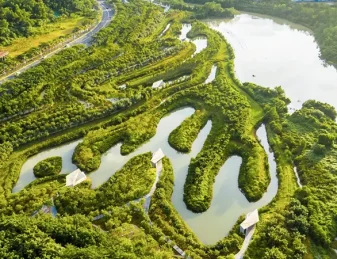
In 2014, the Shanghai People’s Committee issued the “Shanghai Sponge City Plan,” aiming for 40% of the urban area to achieve “sponge” functionality by 2025 and 80% by 2030. The city piloted the 54-hectare Rainbow Bay Park, which functions as a giant sponge capable of naturally infiltrating, filtering, and reusing up to 15,000 m³ of rainwater per day, thereby effectively mitigating urban flooding.

(Source: https://www.citynewsservice.cn/articles/shanghaidaily/in-focus/shanghai-banking-on-sponge-parks-to-become-city-of-ecology-zma8evjn)
Surrounded by residential buildings, the park has adopted the concept of rain gardens - a method designed to treat polluted stormwater runoff through vegetation and “conservation green spaces,” an ecologically sustainable model that minimizes impacts on the surrounding environment while remaining cost-effective. The green spaces use permeable paving bricks and porous concrete (permeable concrete) along pathways to reduce surface runoff and alleviate pressure on the urban drainage system.

(Source: https://www.citynewsservice.cn/articles/shanghaidaily/in-focus/shanghai-banking-on-sponge-parks-to-become-city-of-ecology-zma8evjn )
Thanks to its green transformation efforts, Shanghai has significantly reduced localized urban flooding. Alongside these achievements, however, the city also faces several challenges: large-scale implementation requires extremely high investment costs for both green infrastructure and underground infrastructure (such as sewers and underground storage tanks), while also demanding coordinated collaboration among multiple departments and agencies. The city is striving to improve cross-sector coordination mechanisms and attract private investment to ensure the progress of its ambitious 2030 plan. Nevertheless, this model still has certain limitations in practice: if rainfall exceeds the designed capacity, sponge infrastructure may become overloaded and “not porous enough” to retain and infiltrate water effectively, leading to overflow.
Wuhan - One of the pioneer cities in China implementing the “Sponge city” initiative
Wuhan is one of the pioneering cities in China to implement the “Sponge City” initiative. The Wuhan Sponge City Program aims to reduce localized flooding and improve water quality through the ecological restoration of existing urban water systems, while also developing green infrastructure (vegetation and water surfaces) to collect and store rainwater. The Wuhan Optics valley modern tram system integrates green track technology, helping reduce surface runoff while providing various environmental benefits. The green tracks are designed using permeable materials that allow rainwater to infiltrate through the track foundation, thereby improving stormwater management and reducing flood risks. This design also mitigates the urban heat island effect by cooling surrounding areas through enhanced evaporation. In addition, the green tracks help reduce air pollution by functioning as a natural filter, contributing to the city’s overall environmental health. [7]

(Source: https://global.chinadaily.com.cn/a/201801/20/WS5a6273a9a3106e7dcc1356b7.html )
Shenzhen - A “Sponge shield” along the coast
Shenzhen, a city in China, is a typical example of this initiative. Shenzhen Talent Park features flood-resilient green pathways surrounding a coastal lake, which functions as a reservoir for diversion channels carrying rapid stormwater runoff from the super high-rise Houhai residential district. The pedestrian walkways along the extensive waterfront route of Shenzhen Bay Park, part of the Coastal Recreation Belt, allow water to slowly infiltrate through a thick gravel layer underneath, further slowing the runoff. When the water reaches the impermeable liner at the bottom, gravity guides it along a gentle slope into pipes that discharge back into the ocean, thereby enhancing the city’s water management capacity.

(Source: https://greennetwork.asia/gna-knowledge-hub/sponge-cities-chinas-nature-based-solutions-for-urban-water-management/ )
Shenzhen Bay Park, located near a mangrove nature reserve, is a representative example of sponge city techniques. The park’s 13-kilometer coastline has been kept open and unobstructed, without major infrastructure developments; major highways, buildings, and residential areas are all located further inland, away from flood-prone zones. By planting mangroves and other wetland vegetation along the coast, while also limiting new construction in offshore areas, Shenzhen’s sponge city program has helped protect the city’s population of more than 12 million people from storm surges and rising sea levels.
Implications for Vietnam
In the context of Vietnam’s urbanization, modernization, and urban redevelopment, studying and applying China’s “Sponge City” model represents a new and necessary approach to mitigating urban flooding and addressing climate change toward greener cities. Major cities such as Hanoi and Ho Chi Minh City are key urban centers that are frequently affected by flooding. First, Vietnam needs to establish indicators for stormwater control, permeable surface ratios, and water storage capacity within legal frameworks for urban planning and construction. Second, Vietnam should localize technical standards to suit the country’s climate, geological conditions, and urban development patterns. Third, pilot projects should be implemented in representative cities across different regions, such as Hanoi, Da Nang, and Ho Chi Minh City. In addition to technical and institutional measures, successfully applying the “Sponge City” model in Vietnam also requires appropriate financial mechanisms and long-term operational management.
4. Conclusion: Overall, the “Sponge City” model is a nature-based solution that offers a suitable and long-term approach for developing green urban areas and adapting to the green transition. By fundamentally shifting the conventional mindset from rapid drainage toward the proactive retention and reuse of water through green approaches, this model not only promotes the green transition process but also serves as a key strategy for helping cities effectively respond to increasingly severe urban flooding and climate change.
REFERENCE
- Quản lý môi trường và đô thị (30/05/2022). Ngập úng đô thị – Nguyên nhân cơ bản và đề xuất giải pháp. Tạp chí Kiến trúc.<https://www.tapchikientruc.com.vn/chuyen-muc/ngap-ung-do-thi-nguyen-nhan-co-ban-va-de-xuat-giai-phap.html>, truy cập ngày 21/05/2026
- Ths. Nguyễn Thị Tuyết Hoa, Ths.Trần Thị Thủy, Ths.Nguyễn Thị Ngoan (2025). Mô hình “Thành phố bọt biển”của Trung Quốc và hàm ý chính sách cho Việt Nam. Tạp chí Xây dựng & Đô thị. Số 101.2025.
- World Future Council. (20/01/2016). Sponge Cities: What is it all about? <https://www.worldfuturecouncil.org/sponge-cities-what-is-it-all-about/>, truy cập ngày 21/05/2026
- Duy Anh cùng các cộng sự. (8/12/2025). Thoát nước đô thị. Hồ sơ sự kiện, Tạp chí Cộng sản.<https://hssk.tapchicongsan.org.vn/thoat-nuoc-do-thi-4443.html>, truy cập ngày 21/5/2026
- Vũ Thanh Vân. (08/12/2025). Thoát nước đô thị, từ tiếp cận truyền thống sang tiếp cận bền vững. Hồ sơ sự Kiện, Tạp chí Cộng sản. <https://hssk.tapchicongsan.org.vn/thoat-nuoc-do-thi-tu-tiep-can-truyen-thong-sang-tiep-can-ben-vung-4445.html> , truy cập ngày 21/05/2026
- Ke Jiayun. (14/10/2021). Shanghai banking on sponge parks to become city of ecology. City News Service.<https://www.citynewsservice.cn/articles/shanghaidaily/in-focus/shanghai-banking-on-sponge-parks-to-become-city-of-ecology-zma8evjn>, truy cập ngày 21/05/2026
- TS Tim McGrath, Ths.Huỳnh Trọng Nhân. (02/04/2022). Triển khai mô hình thoát nước bền vững tại một số đô thị vùng ĐBSCL – Kinh nghiệm và bài học. Tạp chí điện tử của Bộ xây dựng (Journal of Construction). <https://tapchixaydung.vn/trien-khai-mo-hinh-thoat-nuoc-ben-vung-tai-mot-so-do-thi-vung-dbscl-kinh-nghiem-va-bai-hoc-20201224000010122.html> , truy cập ngày 26/05/2026
- Stefan Rau. 2022. Sponge Citie: Integrating Green and Gray Infrastructure to Build Climate Change Resilience in the People’s Republic of China. ADB Briefs No.222. DOI: http://dx.doi.org/10.22617/BRF220416-2
- Sponge Teams of Kajiado and Kwa Vonza. (2019). Sponge Town Guideline: How to Create a Sponge Town?. ViaWater Programme, Aqua4All, the Ministry of Foreign Affairs of the Netherlands.
- Nerissa Ng, Communications Team. (25/07/2024). Case studies of Cities in China with Blue-Green Infrastructure. UGHW. <https://ughw.org/blue-green-infrastructure/> , truy cập ngày 26/05/2026

Leave A Comment